
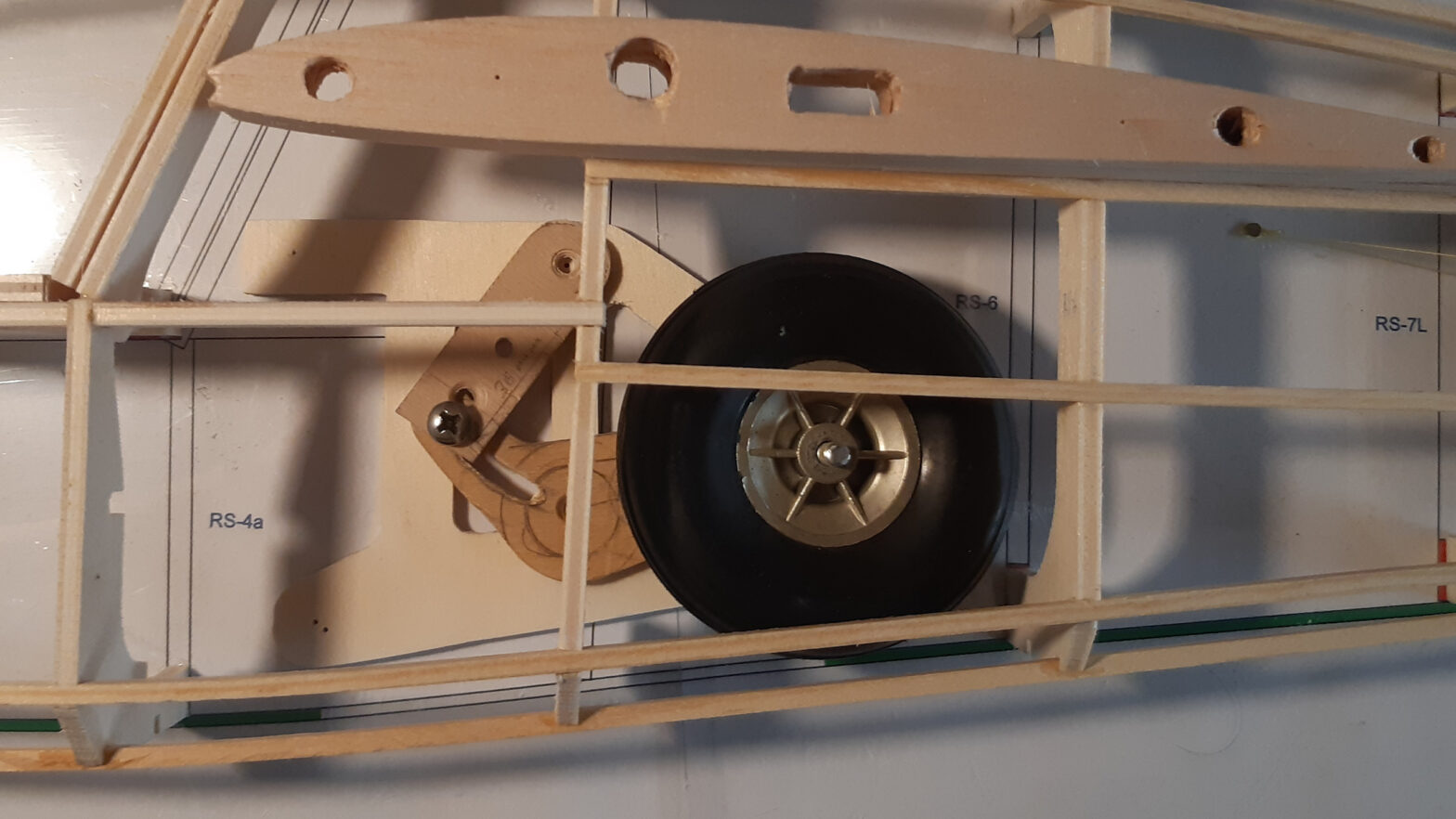
One of the reasons why so much time passed between the start of construction on the Fauvette and the completion of the left fuselage half was my desire to install a retractable landing gear. It’s not strictly necessary, of course, but the idea just wouldn’t leave my mind. And, naturally, it had to be scratch-built…
Weight and cost considerations do favor a scratch-built solution. Even low-priced retractable landing gear units (as of 2026) cost between 130 and 280 euros and weigh between 200 and 270 grams. For a model with a takeoff weight of just 1.6 kg, that’s a tall order. After giving some thought to the operating principle, I needed to assess the available space within the fuselage. To do this, I roughly cut out a few makeshift plywood components using a bandsaw. These parts could then be used to experiment with the layout inside the unfinished left half of the fuselage.
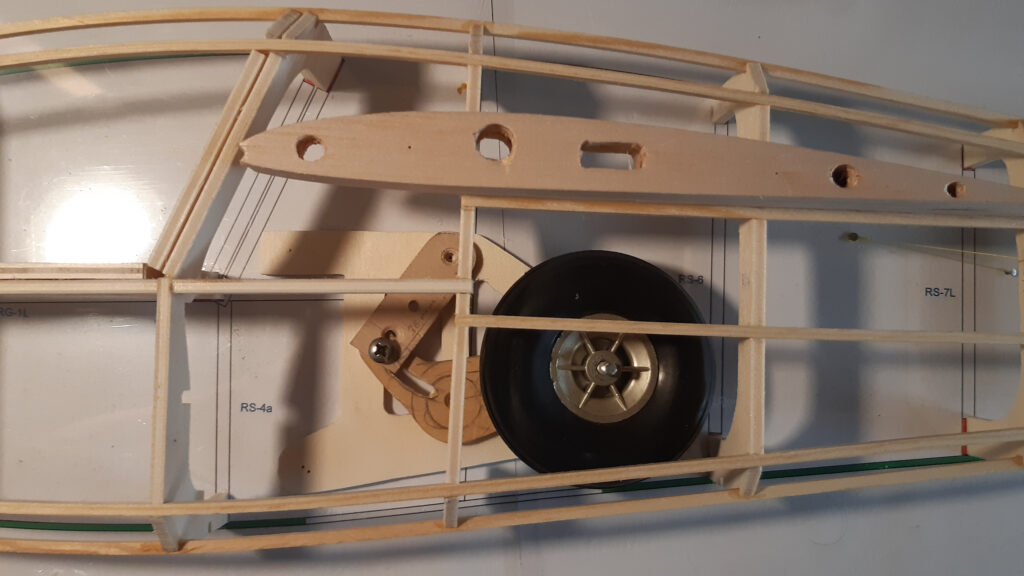
Fortunately, there is just enough space between the 4th and 6th frames to allow the wheel to retract completely. When extended, the landing gear aligns with the 5th fuselage frame, just as the original, fixed wheel mount did.
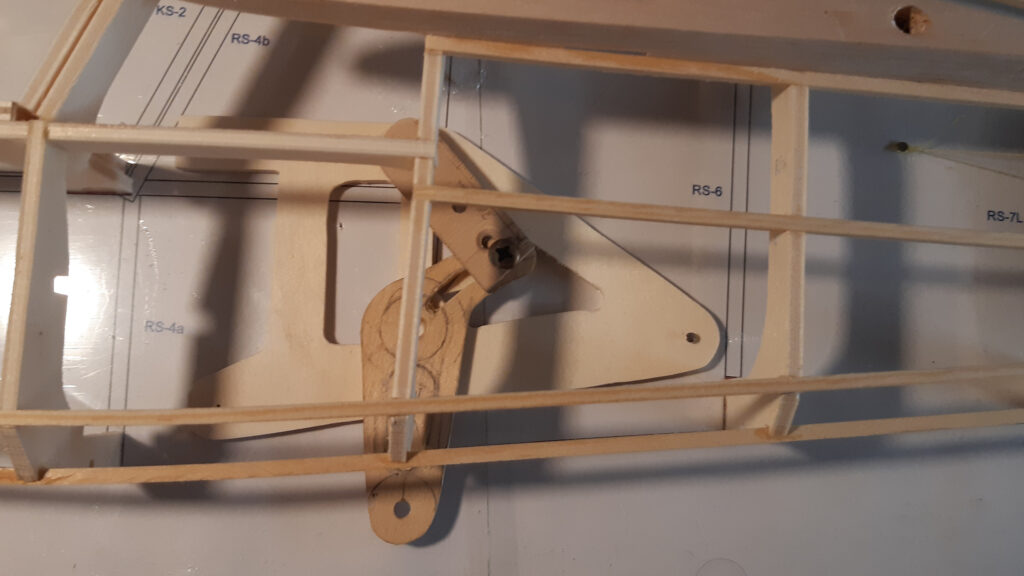
Unfortunately, I didn’t take any photos of the actual landing gear construction, but essentially, I “just” cut the landing gear components shown above out of GRP (fiberglass-reinforced plastic) once again and joined the entire assembly using M3 threaded rods. 4mm outer-diametre brass tubings serve as spacers and abutments. Incidentally, the main wheel comes from my old “Taxi III“. It’s just great to be able to put decade-old components back into service. To increase its lifespan, I pressed a brass sleeve into the main wheel’s axle bore to serve as a bearing.
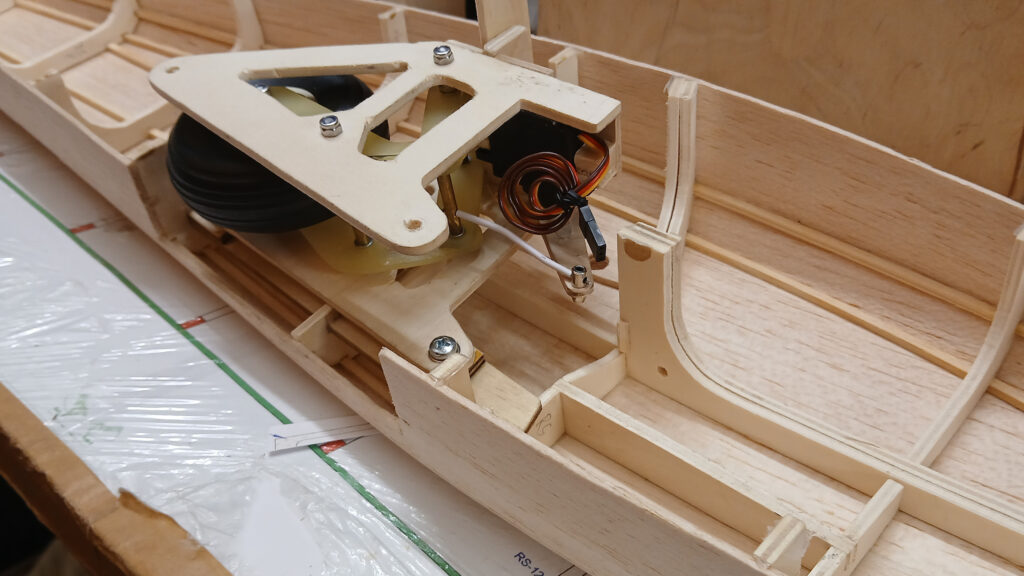
The landing gear is actuated by a 19g servo with metal gears, which easily handles the resistance and weight of the components. The landing gear assembly module can be installed in or removed from the fuselage, thanks to a mounting point I glued in place between frames #4 and #6 along the bottom. Additional support is provided by a clamp at frame #5, designed to absorb the torque generated by landing impacts. Every part was fabricated in duplicate, ensuring they can also be installed in the right-hand side of the fuselage later on.
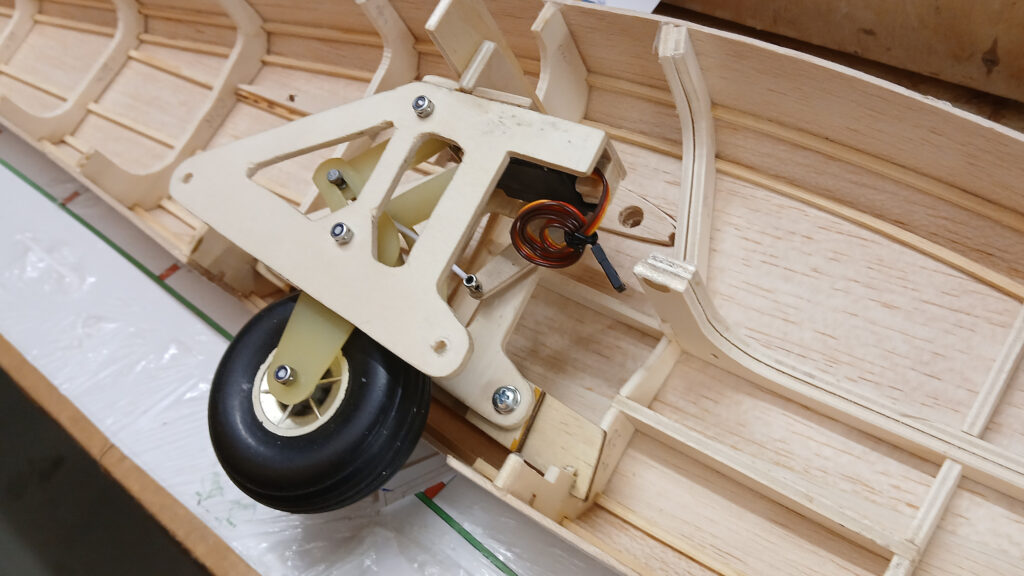
Have I achieved my goal? The finished landing gear, including the servo, weighs just 100 grams. So that is a sound and complete success! And when I add up the costs for all the materials and parts, servo and wheel included, it amounts to approximately 80 euros. In this case, building it yourself is truly superior to a store-bought solution in every respect.
However, it did cost me a great deal of time and nerves. In the end, I abandoned the original plan to equip the entire assembly with a sprung shock absorber, as it would have made the suspension too heavy and too complex. Even as it stands, this side project delayed the construction by nearly half a year.
Have I learned my lesson, and will I now continue the build strictly according to the plan? Good question… time will tell.