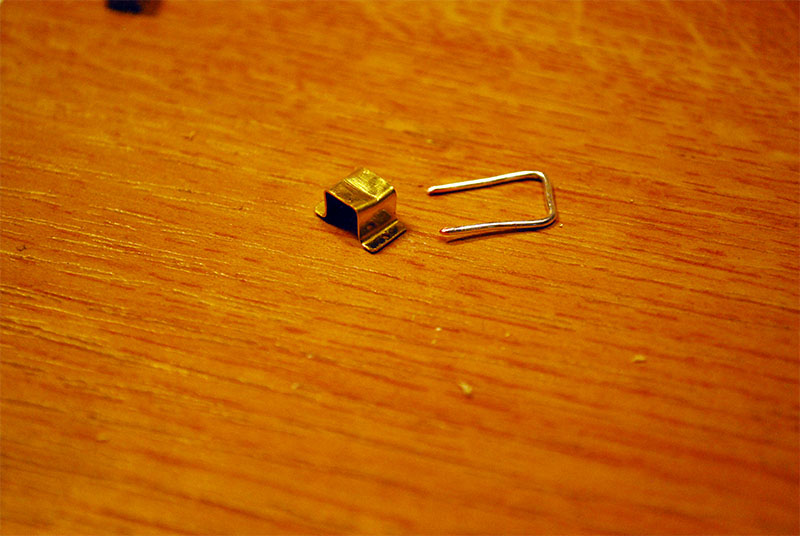
M1,6 square nut soldered to threaded rod, with washer
Of course, the electrical connection between loco and tender made it necesarry to add a coupling between the two before there could be any test runs. In order to stay close to the prototypical concepts and to make a long-lasting connection, I wanted to use threaded rods and square nuts. Unfortunately there was not enough room on the loco to use nbw on both ends, so I soldered a square nut onto a threaded rod with a diameter of 1,6mm. That way it looks like a genuine nbw from the outside, but can be screwed into the thick plastic frame.
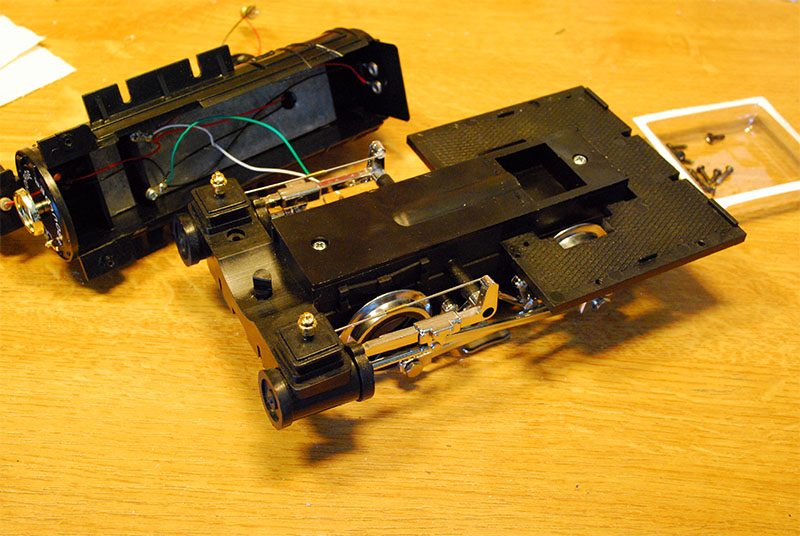
Now that the tender’s basic construction is finished, I wanted to achieve operational readiness. That required the porter loco to get converted from rail to battery power. The most important thing to keep in mind is to insulate the loco’s circuits from the rails in order to avoid “supplying” the rails with the battery’s current. Only then one is completely independent from other loco’s and can really enjoy the advantages of battery power.
By finishing the tender’s frame (german version, translation pending) it’s about time to focus on the side walls. Quite an important part is to build the stake pockets, with the prototype they form the link between the side walls and the frame, with the models most of the time it’s just cosmetics. Since I’d like to build as many parts as possibly by myself and some prototypical pictures revealed that sometimes simple solutions prevail in the 1 : 1 scale, I chose the most primitive approach.
After the basic requirements regarding the dimensions were cleared, an extensive online Image research took place. Apparently, opinions are divided whether a model Porter with a tender is a prototypical sight. Fortunately, I can avoid this topic altogether because I’m not going to model an explicit prototype. Instead, I’ll experiment with different themes and decide on a case-by-case basis whether and to what extend I’ll let the prototype reign supreme or just get some inspiration for my own creations.
Since last September I’ve worked on a project, which I’d like to present now. It’s about a small Portor steam locomotive by LGB, which I want to switch over to battery that is accumulator power, controlled by R/C. At a later time I’d also like to adapt the looks.
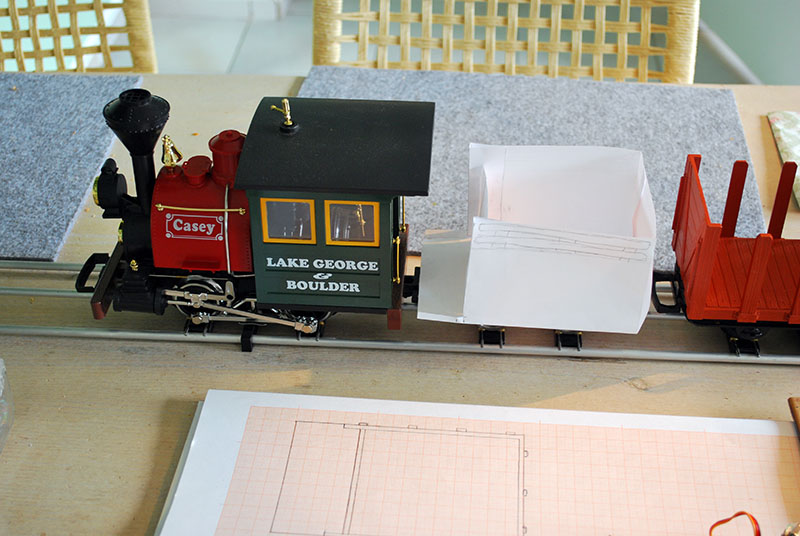
Tender Mockup made of paper
This loco is supposed to make the starting point for my own garden railway, hopefully within this year. September and October were spent with some experiments to place all the necessary components within the locomotive. Alas, I had to take away too much of the lead ballast, so the loco wasn’t able to transmit its motive power to the rails.
Over the past few weeks I’ve spent more time using my camera. In the same time a good friend of my came up with the wish to buy himself a new lens for hiw own camera. He wants an 18-200 zoom to have on the camera most of the time.
When you’re looking up optical performances, prices and functionality for somebody else, you’re inevitably starting to think about your own material. Now I’m wondering: What do I want to achieve with my photos?
Since I don’t have money to waste and I dislike to buy on the first notion, I’ve set up a little challenge for myself, including a goal:
He who takes a picture of 35mm focal length every day and still has fun doing so after 100 pictures, may buy himself a 35mm lens.
What about this silly line?
I’d like to take photos regularly. Practice, practice, practice.
I want to know whether a prime lens suits me better than a zoom.
I need the time (slightly more than three months) to save up enough money for a decent lens.
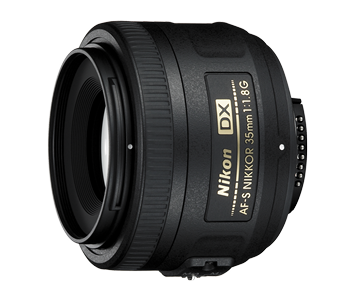
Nikon AF-S DX 35mm 1:1,8G (Copyright Nikon)
So from now on, every day I’m going to set my kit zoom (18-55mm) to 35mm focal length, choose a motive and try to take the best picture I can.
And since for some reason (that I absolutely don’t understand) one tends to be more focused when there’s a goal to pursue, at the end of the road there beckons a 35mm prime lens.
By the way: I chose this specific lens because of a recommendation found at gwegner.de.
From now on I’d like to to document my first steps as being an amateur photograph.
Hence, a new category and a new post.
This web site uses cookies to support language selection and comment functionality. No other user-related data is tracked. You can find further information in our Privacy Policy.